
The Reflective Functioning Five Minute Speech Sample (RF-FMSS)
WHAT IS THE RF-FMSS?
The Reflective Functioning Five Minute Speech Sample (RF-FMSS) is a brief, clinically accessible measure of parental reflective functioning developed by Dr. Tina Adkins in collaboration with Peter Fonagy at University College London and the Anna Freud Centre.
The RF-FMSS was designed to assess a parent's capacity to understand their child's behavior in terms of underlying mental states — thoughts, feelings, intentions, and emotional experience — using a structured five-minute speech sample rather than a lengthy clinical interview.
THE PROBLEM IT SOLVES
Existing measures of parental reflective functioning — including the Parent Development Interview (PDI) and the Adult Attachment Interview (AAI) — are among the most robust tools available for assessing mentalizing capacity. They are also among the most resource-intensive.
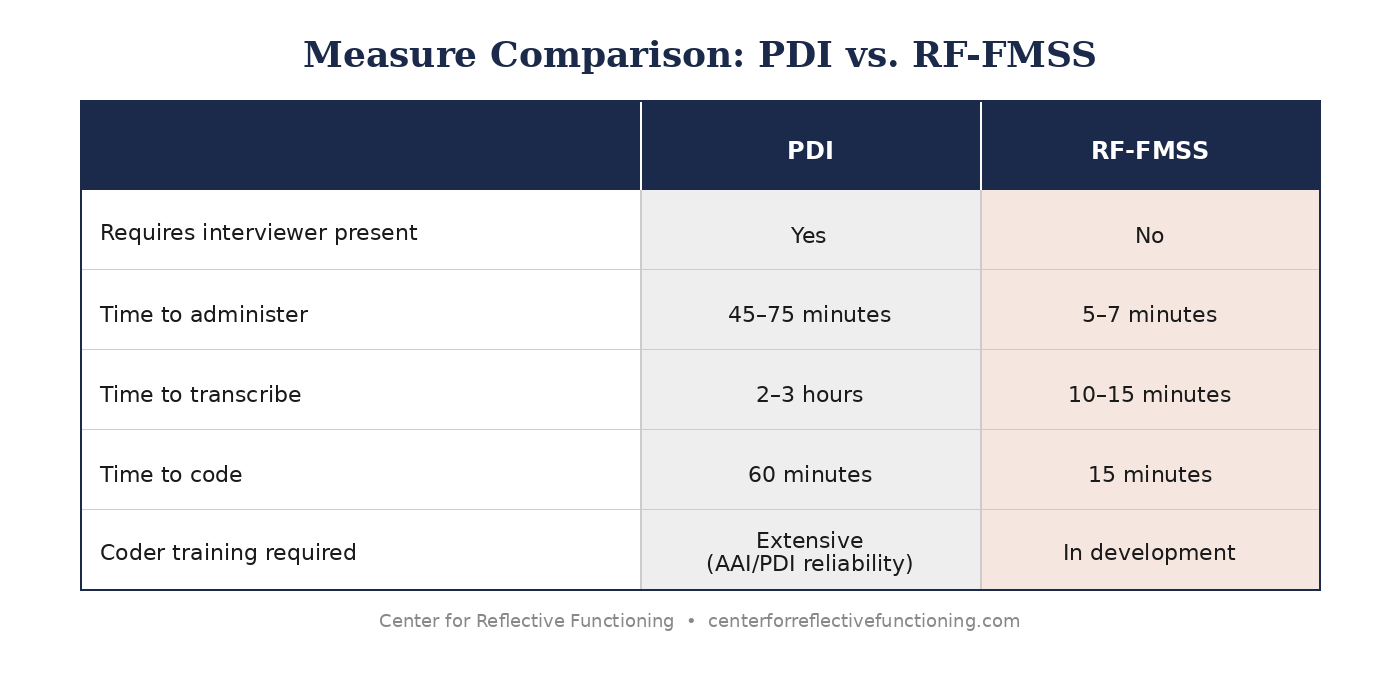
The RF-FMSS was developed to provide a clinically meaningful and accessible alternative — one that could be used in research, training, and applied practice settings where longer interviews are not feasible.
HOW IT WORKS
The RF-FMSS uses four structured prompts inviting caregivers to describe their child, share their feelings about the relationship, reflect on the child's imagined experience of them, and describe a recent challenging interaction. Prompts were selected for their alignment with questions from the Parent Development Interview, which was specifically designed to elicit reflective functioning and assess internal working models of caregiving relationships.
Responses are audio-recorded, transcribed, and coded using the Reflective Functioning Scale (Fonagy, Target, Steele & Steele, 1998) — the same validated coding system used with the AAI and PDI. Scores range from –1 (active rejection of mentalizing) to +9 (exceptionally sophisticated reflective functioning), with a score of 5 indicating clear, consistent reflective capacity. Inter-rater reliability in the original validation study was strong, with an intraclass correlation of ICC = 0.85.
CODING TRAINING — IN DEVELOPMENT
Currently, reliable coding of the RF-FMSS requires prior training in reflective functioning coding on the Adult Attachment Interview or Parent Development Interview. This is a known barrier — both measures require extensive and costly training to achieve coding reliability.
Dr. Adkins is actively developing a standalone RF-FMSS Coding Training Program based on a simplified adaptation of the Reflective Functioning Scale coding manual. This training will be designed specifically for the RF-FMSS, making reliable coding accessible without prerequisite AAI or PDI training.
Peter Fonagy has supported this development direction, recognizing the measure's potential for broader clinical and research dissemination.
Information about training availability will be posted here as it becomes available.
VALIDATION
The RF-FMSS has been formally validated against the Parent Development Interview (PDI) in a community sample of 61 parents. Concurrent validity was significant (r = .464, p < .001), with average RF scores of 4.15 on the PDI and 4.49 on the RF-FMSS — consistent with average reflective functioning in a non-clinical population.
Importantly, the RF-FMSS showed no significant correlations with demographic variables including marital status, gender, employment, income, or number of children — supporting its discriminant validity across diverse populations.
A full validation manuscript is currently in preparation:
Adkins, T., Dosanjh, L., & Fonagy, P. (in preparation). Validation of a new measure of parental mentalizing: The Reflective Functioning Five Minute Speech Sample (RF-FMSS).
INDEPENDENT SCHOLARLY UPTAKE
Since its development, the RF-FMSS has been adopted by independent research teams across six countries. To date, 12 published studies have used the measure across a wide range of populations, settings, and intervention contexts.
Studies Using the RF-FMSS
Foundational Studies
Adkins, T., Luyten, P., & Fonagy, P. (2018) Development and preliminary evaluation of Family Minds: A mentalization-based psychoeducation program for foster parents. Journal of Child and Family Studies, 27(8), 2519–2532.
Adkins, T., Reisz, S., Hasdemir, D., & Fonagy, P. (2022) Family Minds: A randomized controlled trial of a group intervention to improve foster parents' reflective functioning. Development and Psychopathology, 34(3), 1177–1191.
Bammens, A-S., Adkins, T., & Badger, J. (2015) Psycho-educational intervention increases reflective functioning in foster and adoptive parents. Adoption and Fostering, 39(1), 38–50.
Independent Studies
Bate, J., Bekar, O., & Blom, I. (2018) A mother, a baby, and two treatment approaches: Discussing a switch case from CBT and mentalization perspectives. Journal of Infant, Child, and Adolescent Psychotherapy, 17(4), 328–345. Perinatal mental health program, Lenox Hill Hospital, New York.
Leyton, F., Olhaberry, M., et al. (2019) Video feedback intervention to enhance parental reflective functioning in primary caregivers of inpatient psychiatric children: Protocol for a randomized feasibility trial. Trials, 20, 268. Child and adolescent inpatient psychiatric unit, Valparaíso, Chile.
Kerr, M.L., Charles, P., et al. (2022) Development and implementation of an attachment-based intervention to enhance visits between children and their incarcerated parents. In Krysik, J. & Rodriguez, N. (Eds.), Children of Incarcerated Parents. Springer, Cham. Dane County Jail, Wisconsin, USA.
Cooke, S., Cooke, D.C., & Hauck, Y. (2023) Relationship focused mother–infant groups: Preliminary evaluation of improvements in maternal mental health, parenting confidence, and parental reflective functioning. Infant Mental Health Journal, 44, 705–719. Community mother–infant program, Western Australia.
Kerr, M.L., Charles, P., et al. (2024) Enhancing remote parent–child video visits during parental incarceration using IMMERSIVE, a brief mindful relational savoring intervention. Mindfulness, 15, 3080–3094. Families of incarcerated parents, Wisconsin, USA.
Åkerman, A-K.E., Holmqvist, R., et al. (2024) Experiences in the relationship between foster children and foster parents in specialized foster care: Thematic analysis conducted on five minute speech sample data. Children and Youth Services Review, 167, 107999. Specialized foster care, Linköping, Sweden.
Linde-Krieger, L.B., & Rankin, L. (2025) Infant carrying to enhance parental reflective functioning in early childhood: A model of direct and indirect pathways in a sample of adolescent mothers. Attachment & Human Development, 27(3), 456–479.
Zitzmann, J., Georg, A., Rosenbach, C., & Renneberg, B. (2025) "If I could read your mind…": Parental mentalizing in mothers with borderline personality disorder. Borderline Personality Disorder and Emotion Dysregulation, 12, 20. Multi-site clinical study, Germany.
Marshall, C., Gregory, J., Donnelly, K., & Hoshi, R. (2026) Impact of an attachment- and trauma-informed training intervention for social care professionals. Developmental Child Welfare, 8(1), 22–39.
POPULATIONS & CONTEXTS
The RF-FMSS has been used across a notably diverse range of populations and research contexts, including:
Foster and adoptive parents
Adolescent mothers
Mothers with borderline personality disorder
Perinatal women experiencing depression and anxiety
Incarcerated parents
Caregivers of children with psychiatric hospitalizations
Mother–infant dyads in community settings
Foster children and young people
Social care professionals
ACCESSING THE RF-FMSS
The RF-FMSS procedure and coding manual are currently available for research and training purposes. Researchers and clinicians interested in using the measure are warmly encouraged to reach out directly.
For inquiries regarding:
Access to the RF-FMSS procedure and coding manual
Research collaborations
Coding training and consultation
Citation guidance
Please contact Dr. Adkins at: dradkins@centerforreflectivefunctioning.com
CITATION
When using the RF-FMSS, please cite:
Adkins, T., & Fonagy, P. (2022, 2025). The Reflective Functioning Five Minute Speech Sample Procedure. Unpublished manual.
Adkins, T., Luyten, P., & Fonagy, P. (2018). Development and preliminary evaluation of Family Minds: A mentalization-based psychoeducation program for foster parents. Journal of Child and Family Studies, 27(8), 2519–2532.